
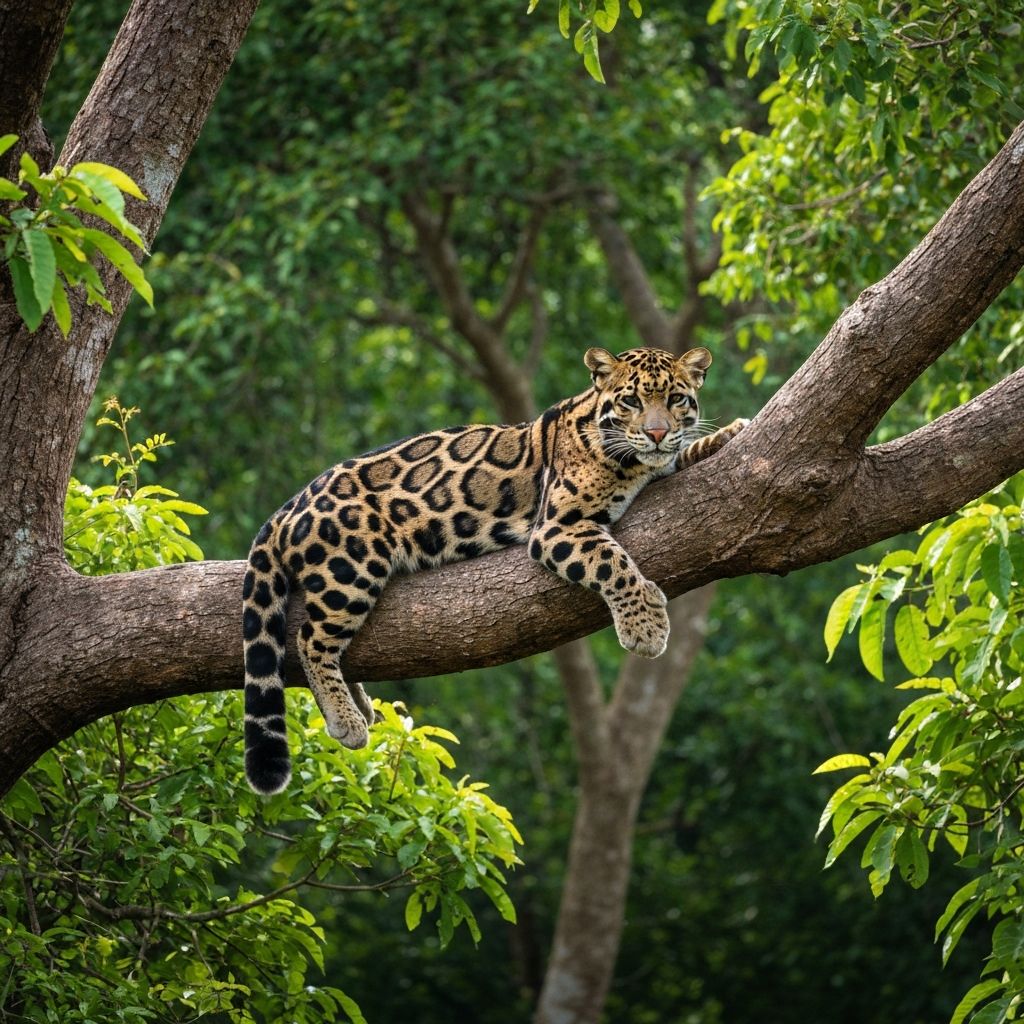
Every year on August 4th, the world marks International Clouded Leopard Day, a spotlight one of Asia's most secretive big cats. In Bangladesh, the clouded leopard survives in small, scattered pockets of the Chittagong Hill Tracts, listed as Critically Endangered due to habitat fragmentation, snaring, and prey loss. Yet hope persists, recent camera-trap records show this elusive predator is still holding on. Through the Beyond Border project, Arannayk Foundation is actively working to secure the clouded leopard's habitats.
Every year on August 4th, wildlife enthusiasts, conservationists, and nature lovers around the world unite to celebrate International Clouded Leopard Day. This special observance raises awareness for one of the world's most breathtaking, secretive, and vulnerable big cat species. These remarkable predators play a vital role in maintaining healthy forest ecosystems across Asia. However, habitat loss and poaching continue to threaten their survival. This blog highlights the importance of Clouded Leopard and puts spotlight toward Bangladesh, a critical landscape for Clouded Leopard conservation, to explore what makes this magnificent cat so unique, the challenges it faces locally and globally, and what we must do to ensure its wild future.
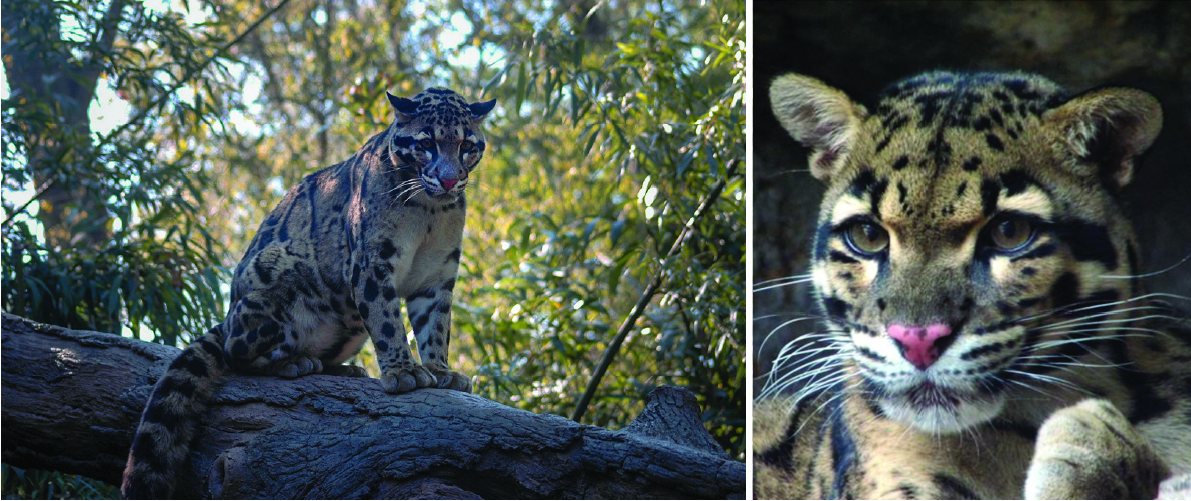 The Clouded Leopard © The Brit_2
Global, National, and Local Names
The Clouded Leopard found in Bangladesh is locally known as lam chita and is often called gecho bagh or lota bagh. According to Khan 2018, indigenous communities also know it by several local names, including Tkai Khe in Khumi, Tai Tokeya in Marma and Rakhain, and Tam in Mro. It carries the common English name Mainland Clouded Leopard, while its official scientific name is Neofelis nebulosa (Griffith, 1821). The striking cloud-like pattern on its coat is directly connected to how the animal received its common name.
Species Biology
This medium-sized wild cat has a body of 85 cm, a large head, and a relatively long 72 cm tail, with an overall weight ranging from 11.5 to 18 kg. Its coat features an ochre background marked with dark-bordered grey blotches, facial spots, cheek stripes, and black rings along the tail. Sunquist and Sunquist (2002) highlight that relative to its skull size, it possesses the longest canine teeth of any wild cat, alongside its unusually long tail. The species occasionally utters soft meowing sounds, and females breed primarily between October and January, raising their cubs inside hollow tree holes.
Habits
Mainly nocturnal, highly arboreal, and secretive, this cat is rarely encountered by humans due to its elusive nature. It has relatively lightweight body that enables it to hang upside down from branches using its hind feet and tail, as well as can quickly climb down tree trunks headfirst. This cat operates as an ambush predator both in the canopy and on the ground, and hunts small- to medium-sized vertebrates, including ungulates, primates, rodents, and birds.
Geographic Range
Mainland Clouded Leopards strongly prefer dense forest habitats, especially primary tropical evergreen rainforests, though they occasionally inhabit dry deciduous forests, secondary logged woods, grasslands, scrub, and mangrove swamps. Tracking studies in Thailand confirm their strong preference for thick forest cover over open ground. Globally, their range spans from Nepal through mainland Southeast Asia into China up to elevations of 3,500 meters, though they are now extinct in Taiwan and near extirpation in Vietnam, China, and Bangladesh. Resident populations persist in Bangladesh, Bhutan, Cambodia, China, India, Lao PDR, Malaysia, Myanmar, Nepal, and Thailand. Nationally, Khan 2018 notes their presence in Bangladesh across the southeastern Chittagong Hill Tracts, the northeastern Sylhet region, and northern deciduous patches across Jamalpur, Sherpur, Mymensingh, and Netrokona.
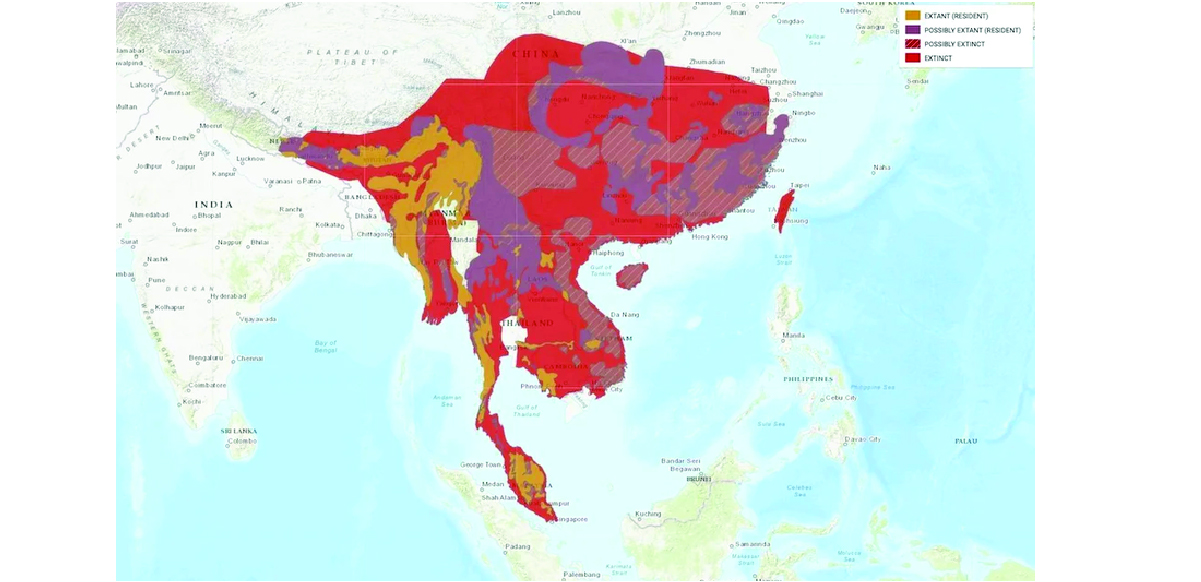 The current and historical range of the clouded leopard © Gray et al. 2021.
Global Population, Home range, and Status
Globally, the species is classified as Vulnerable, with a declining population estimated at 3,700 to 5,580 mature individuals. In Thailand, radio-telemetry reveals that adults occupy home ranges between 30 and 40 km², with smaller core areas of 3 to 5 km². In Bangladesh, the exact population count is unknown, but the species is listed as Critically Endangered due to rare observation, habitat fragmentation, forest loss, and illegal poaching.
Observation Records in Bangladesh
Once feared extinct in Bangladesh due to deforestation and prey loss, the clouded leopard has been periodically re-confirmed over the past decade. A 2009 sighting in Rangamati and a rescued kitten in Srimangal (2013) proved its ongoing presence in the north & southeast. In 2016, Creative Conservation Alliance (CCA) surveys in the Chittagong Hill Tracts (CHT) brought media attention through The Guardian. Camera traps set by parabiologists between 2011 and 2015 confirmed surviving individuals in the Sangu-Matamuhuri Reserve Forest. Research done by Dr. Suprio Chakma between 2010-11, alongside CCA and the Wildlife Trust of Bangladesh, confirmed that the cat still breeds in CHT’s primary strongholds like Sangu-Matamuhuri, Kassalong-Sajek, Bandarban, and Barkal. The primary stronghold in the Chittagong Hill Tracts within the Sangu-Matamuhuri Reserve Forest along the Myanmar border, the Kassalong–Sajek Reserve Forest in Rangamati bordering the Dampa Tiger Reserve landscape in Mizoram, India, and the Bandarban and Barkal areas. Secondary or historical ranges across the northeastern belt including Sylhet, Moulvibazar, Sherpur, and Netrokona show historic connectivity, though contemporary presence in these fragmented patches is extremely rare or transient. According Chakma 2016, long-term survival in the Chittagong Hill Tracts relies on maintaining contiguous cross-border forests linking directly to Dampa Tiger Reserve in Mizoram, India, and the Rakhine Yoma range in Myanmar.
In bordering areas of India closest to the Chittagong Hill Tracts, records from Jhala et al. 2020 confirm presence in Dampa Tiger Reserve, Mizoram. Published density estimates by Singh and MacDonald 2017 in Dampa report 5.1 individuals per 100 km², which is amongst the highest recorded across the species' range, and research indicates Mainland Clouded Leopards may occur at higher densities when densities of larger cats like tigers and leopards are lower.
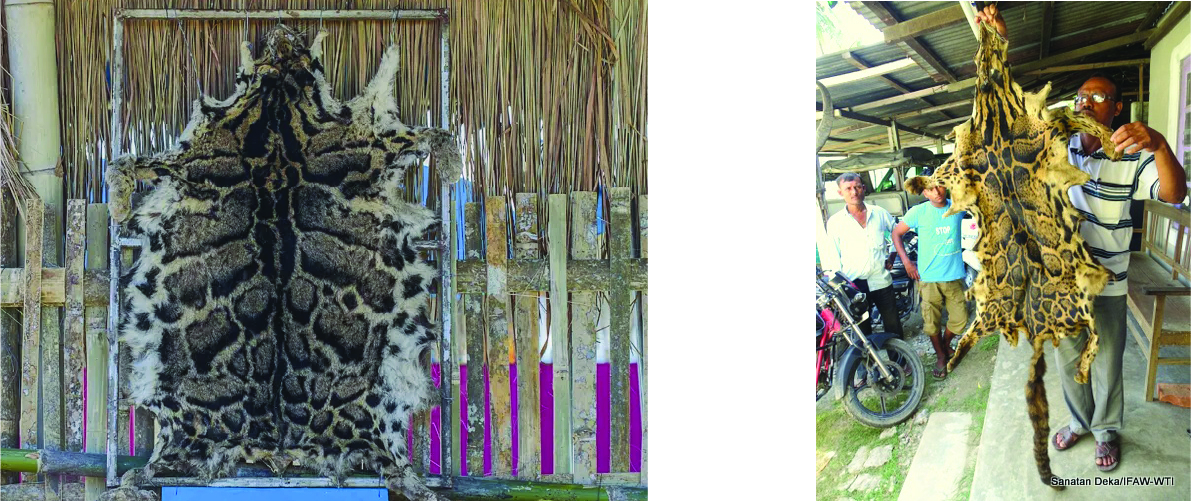 Confiscated Clouded Leopard Pelt (Left) | Clouded Leopard Skin Seized in Assam (Right) © Global Conservation | Sanatan Deka - IFAW WTI
Threat
Globally, population declines are driven by illegal hunting for the wildlife trade, where skins are sold for luxury decor, bones serve as substitutes for tiger bone in traditional Asian medicine, meat is consumed as an exotic dish, and live animals enter the pet trade. Snaring, prey loss, and climate change impacts (as noted in Nepal) add further pressure. Specifically in Bangladesh, key threats include Jhum (slash-and-burn) agriculture that fragments forests, indiscriminate wire-snaring set for deer and wild pigs, targeted poaching of cubs for local trade or retaliatory killing, and severe prey depletion from overhunting.
Conservation Actions
The species is protected internationally under CITES Appendix I and through national laws across its range. In Bangladesh, it is protected under Schedule 1(B) of the Wildlife Conservation and Security Ordinance 2026, making hunting, trade, transport, or harassment strictly illegal. Section 37 of the Ordinance outlines severe penalties, first-time offenders face up to 3 years in prison, a fine up to BDT 300,000, or both, while repeat offenses carry up to 5 years imprisonment and a fine up to BDT 500,000. Forest officials and law enforcement are empowered to arrest suspects without a warrant for cognizable offenses.
What to Do to protect
As historical population trends remain unknown, establishing long-term monitoring systems is a priority. Internationally, protection requires joint transboundary planning, improved management of protected areas using the Zero Poaching toolkit, and achieving Conservation Assured Tiger Standards. Global action points include restoring ecological corridors between Bangladesh, India, Myanmar, Thailand, and Lao PDR, strengthening anti-snaring patrols, clamping down on illegal trade routes, standardizing camera-trap surveys, and supporting local community co-management and livestock loss compensation. Specifically for Bangladesh, priority actions may include formalizing wildlife corridors in Sangu, Matamuhuri, and Kassalong Reserve Forests, establishing joint anti-poaching frameworks with India and Myanmar, and partnering with CHT indigenous communities to transition away from hunting and mitigate human-wildlife conflict.
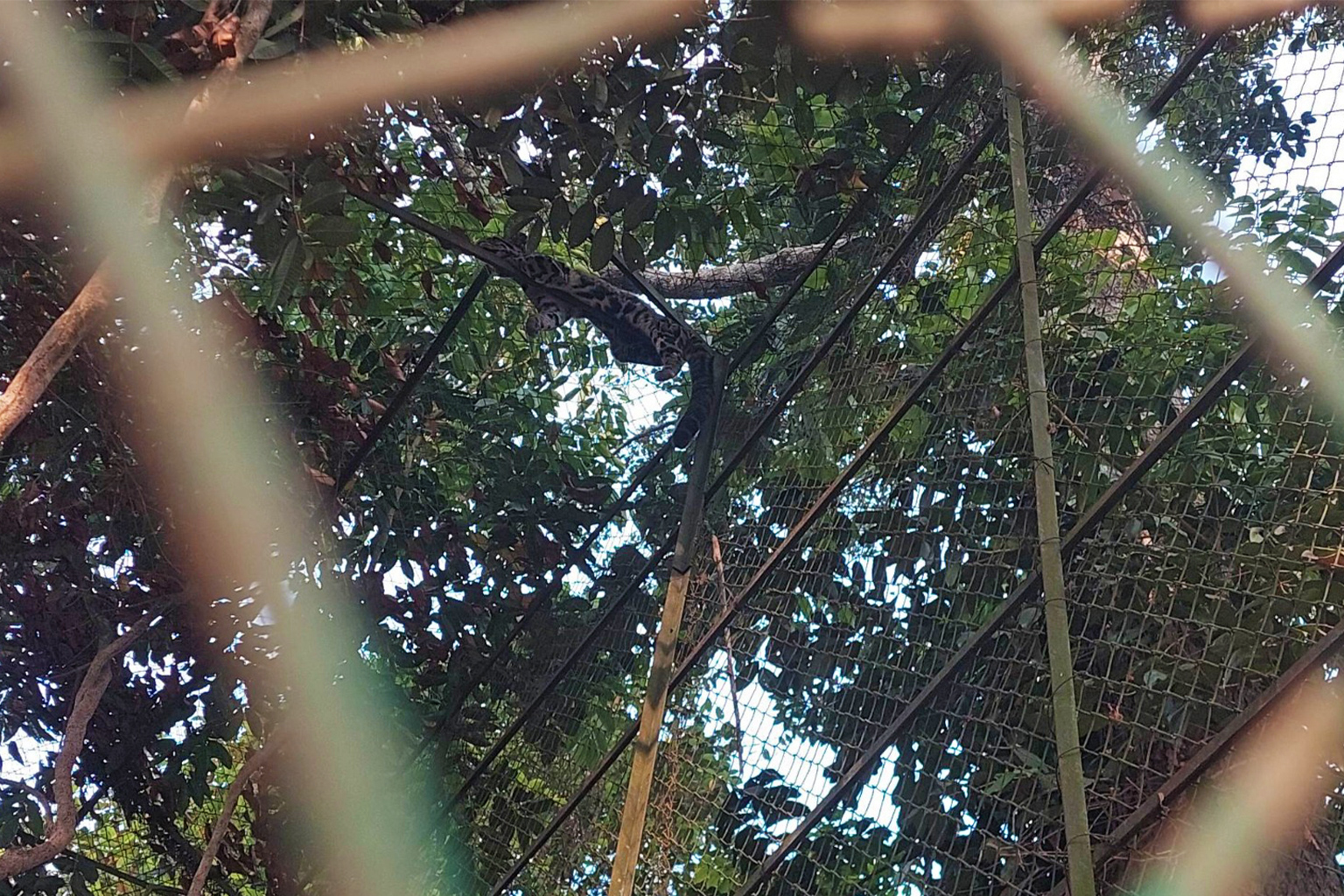 The only observed specimen of clouded leopard in Bangladesh is now living at Dulahazara Safari Park in Cox’s Bazar district © Fahim Zaman
A Call to Action for International Clouded Leopard Day
The clouded leopard's survival in Bangladesh brings hope that nature can endure against the odds. However, saving the species requires strong anti-poaching laws, cross-border cooperation, and close partnerships with local indigenous communities.
To turn hope into action, the Arannayk Foundation is implementing the ‘Beyond Border: Securing Big Cats and Their Habitats across the Chittagong–Lushai Transboundary Landscape of Bangladesh and India’. The project is co-financed by the Federal Republic of Germany through KfW Development Bank and IUCN, International Union for Conservation of Nature under Integrated Tiger Habitat Conservation Programme (ITHCP). This initiative aims to protect key big cats including Clouded Leopards and Leopards in the Kasalong and Sangu–Matamuhuri Reserve Forests, Pablakahali Wildlife Sanctuary in Bangladesh connecting to India's Dampa Tiger Reserve.
The project is carrying out a holistic, landscape-level strategy combining spatial ecological monitoring, community-led habitat restoration, and sustainable livelihood support across key protected areas in the Chittagong Hill Tracts (Bandarban and Rangamati) and adjacent transboundary forests in Mizoram. For clouded leopard conservation in Bangladesh, this initiative directly addresses habitat fragmentation by identifying and securing critical biological corridors between Kassalong, Sangu-Matamuhuri, and Mizoram's forest landscapes. A core priority of the project is supporting community infrastructure, such as establishing community-managed facilities, securing clean water supplies, and improving healthcare and education support systems to foster long-term local resilience. By empowering indigenous communities with climate-resilient alternative livelihoods, building local Youth Conservation Volunteer groups as active stewards, and mitigating human-wildlife conflict, the project reduces anthropogenic pressure and poaching risk, safeguarding essential movement pathways and ensuring long-term population viability for clouded leopards in their primary remnant habitats in Bangladesh. These grassroots actions are reinforced by broad policy dialogues, local conservation festivals, school engagement, and awareness campaigns.
Let International Clouded Leopard Day be a reminder that keeping our forests wild, connected, and protected ensures that this majestic predator continues to roam the wild hills of CHT for generations to come.
References
Chakma, S., 2016. Assessment of large mammals of the Chittagong Hill Tracts of Bangladesh with emphasis on tiger (Panthera tigris). PhD thesis. University of Dhaka. Available at: http://reposit.library.du.ac.bd:8080/xmlui/bitstream/handle/123456789/1338/Suprio%20Chakma.pdf?sequence=1&isAllowed=y
Creative Conservation Alliance. 2016. A preliminary wildlife survey in Sangu-Matamuhuri Reserve Forest, Chittagong Hill Tracts, Bangladesh. Unpublished report submitted to Bangladesh Forest Department, Dhaka, Bangladesh. Available at: https://rhinoresourcecenter.com/wp-content/uploads/2018/05/1563611856.pdf
Global Conservation. n.d. Global Conservation. Available at: https://globalconservation.org/ (Accessed: 3 August 2026).
Government of Bangladesh. 2026. The Wildlife Conservation and Security Ordinance, 2026. Ministry of Law, Justice and Parliamentary Affairs. http://bdlaws.minlaw.gov.bd/upload/act/2026-01-12-09-51-46-Ordinance-No.-9-of-2026.pdf
Gray, T.N.E., Borah, J., Coudrat, C.N.Z., Ghimirey, Y., Giordano, A., Greenspan, E., Petersen, W., Rostro-García, S., Shariff, M. & Wai-Ming, W. 2021. Neofelis nebulosa. The IUCN Red List of Threatened Species 2021: e.T14519A198843258. https://dx.doi.org/10.2305/IUCN.UK.2021-2.RLTS.T14519A198843258.en. Accessed on 03 August 2026.
Jhala, Y.V., Qureshi, Q. and Nayak, A.K. 2020. Status of tigers, copredators and prey in India, 2018. National Tiger Conservation Authority, Government of India, New Delhi, and Wildlife Institute of India, Dehradun.
Khan, M.M.H. 2018. Photographic Guide to the Wildlife of Bangladesh. Arannayk Foundation, Dhaka, Bangladesh. 488 pp.
Singh, P. and Macdonald, D.W. 2017. Populations and activity patterns of clouded leopards and marbled cats in Dampa Tiger Reserve, India. Journal of Mammalogy 98: 1453-1462.
Sunquist, M. and Sunquist, F. 2002. Wild Cats of the World. University of Chicago Press.
TBS Report. 2021. Int'l Clouded Leopard Day: The tiny cat that makes you paws. The Business Standard. https://www.tbsnews.net/bangladesh/environment/intl-clouded-leopard-day-tiny-cat-makes-you-paws-283612

Comments