High in the hills of Chakboitha, everyday life once stumbled over the struggle to find water. Families walked long distances to collect it, often leaving children behind and bringing home water that was not always safe to drink. Now, a community-managed water system is bringing treated water closer to 89 households across three hills. But the real story is what happens when water comes closer, and whether the community can keep it flowing.
You wake up in the morning, but your day cannot begin yet. First, you have to find enough water to get through it. You need it for drinking, cooking, bathing and cleaning.
High on the hills of Chakboitha, a remote village in Ukhiya, Cox’s Bazar, getting enough can mean walking to a distant source, carrying water home and sometimes going back again.
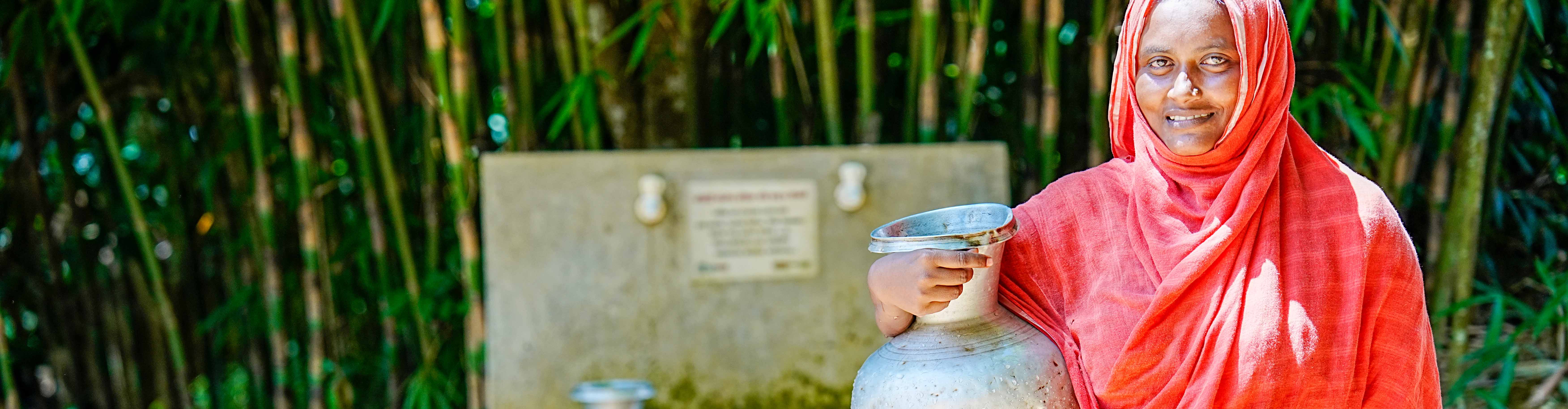
For Momena Begum, this was once part of everyday life in the remote village of Ukhiya, Cox’s Bazar.
I had to spend a lot of time collecting water. If we needed more water later in the day, I had to go again. It was tiring, especially when I had other work waiting at home.
Momena was not alone.
Families living across the three hills of Chakboitha faced the same struggle. The steep terrain made access difficult. The available water sources also had high levels of iron and were considered unsuitable for drinking.
For the families, water scarcity was therefore about more than distance.
It affected time, household work, children's care, hygiene and health.
When water becomes a health concern
The wider health picture makes the struggle in Chakboitha harder to ignore. In Cox’s Bazar, water and hygiene problems can quickly become health problems. In Rohingya camps, that share the same landscape, 31% of children under five had a skin infection, 20% had experienced diarrhoea (Butt et al., 2025).
44% of Diarrhoea patients from this area had some or severe dehydration. (Faruque et al., 2021).
For families in Chakboitha, these concerns are not statistics they encounter in a report. They experience them at home.
Children suffered from skin problems. Bathing and maintaining personal hygiene became difficult. Families also had to think twice about drinking water that contained iron.
So the need was clear.
Chakboitha needed water that was closer, more reliable and safer to use.
Arannayk Foundation looks beneath the hills
Arannayk Foundation's GREEN LIFE project, supported by USAID, came to Chakboitha with a practical response to the community's water problem.
The search began underground.
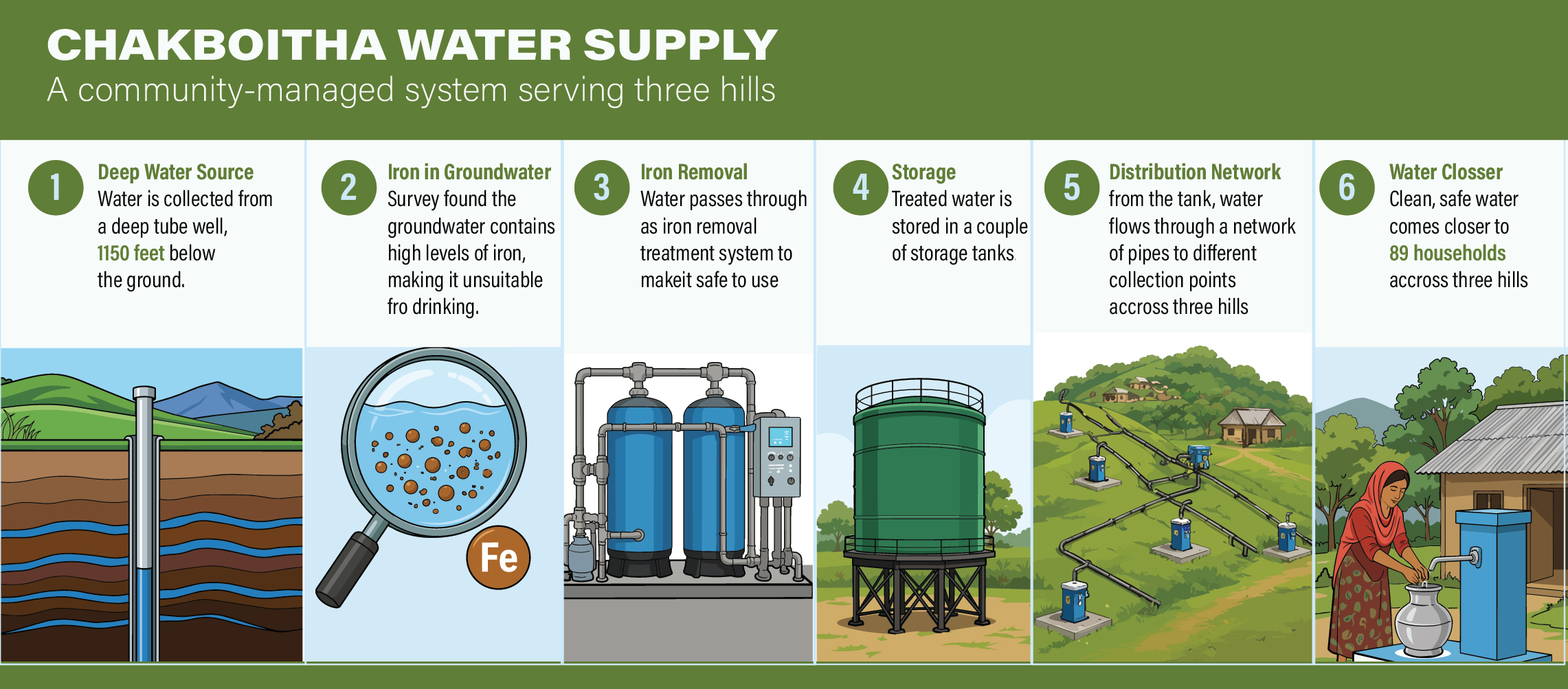
The project team explored deep groundwater sources. A tube well reaching around 700 feet could not provide enough water.
The survey also found high levels of iron in the groundwater.
Finding water was only half the challenge.
The project needed a way to treat the water so families could use it more safely.
An iron-removal system became part of the solution. The water supply system also includes storage, networking and collection points. A 7,500-litre water tank supports the supply.
Today, the community-managed commercial water supply serves 89 households across the three hills.
The project has installed infrastructure and water comes closer to home.
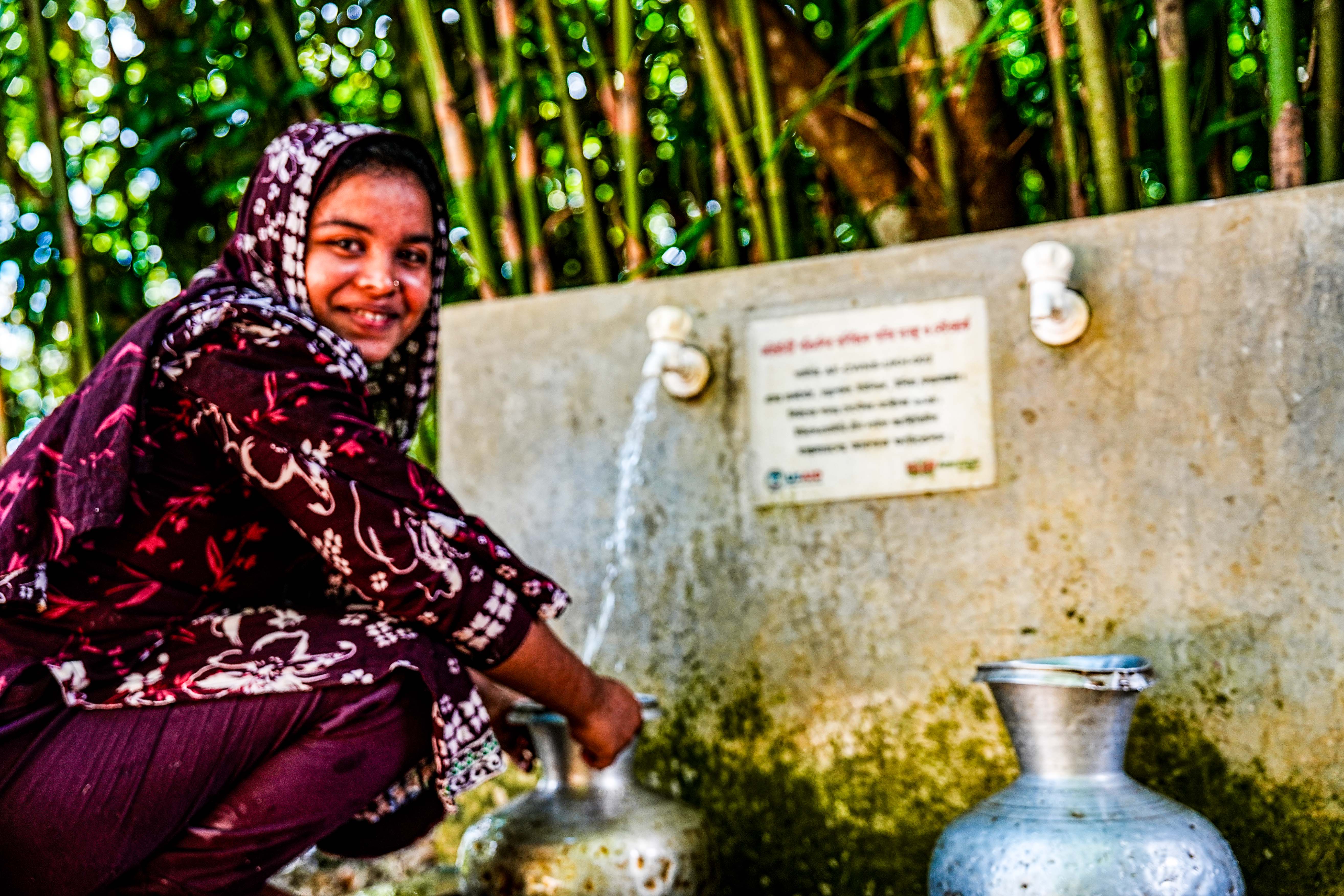
For Momena, that changes the way her day begins.
Now I can collect the water much more easily. I do not have to spend the same amount of time going from one place to another. I can finish the work and return home much earlier.
The time she once spent searching for water can now go to other parts of her day. She can return home sooner. She can spend more time with her family.
She can get on with the work that was waiting for her.
Before, collecting water could take a large part of my morning. Now I have more time to take care of my family and do other work.
For Momena, this is where the value of the water system becomes visible.
A system the community manages
The water now comes closer to home. But keeping the system running is a responsibility the community shares.
A committee has been formed with members from the Chakboitha community to oversee the water supply. Each of the 89 households contributes BDT 1,000 every month to keep the system running.
The money covers the system's electricity bills and maintenance costs. This regular contribution gives the households a direct role in sustaining the water supply they depend on.
For Abdul Hakim, a Chakboitha resident, that responsibility begins with a simple idea: the water belongs to everyone who depends on it.
This water supply belongs to the community. We all depend on it, so we also have a responsibility to look after it. If everyone does their part, the system can continue to serve us for a long time.
The arrangement turns the water supply into more than a project facility. The community has a committee to oversee it, a monthly contribution to cover its running costs and a shared responsibility to keep it functional.
For the 89 households across Chakboitha's three hills, that means water can remain part of everyday life without depending entirely on outside support.
A mother can spend less time walking for water. Children can stay closer to home. Bathing and household hygiene can become easier. And the community has a system in place to keep the water flowing.
The water has come closer. Now, the community is keeping it going.
* The opinions expressed here are the author’s own and do not represent the official views of Arannayk Foundation.
References
Butt, S., Chowdhury, M. S. R., Sadique, S., Faisal, A. A., Mahama, A., Gorski, A., Pop-Stefanija, B., Beversluis, D., Lochokon, J. M., Velivela, K., Uadiale, K., Rahman, M. M., Worku, T. G., Billiew, T. J. G., & Keating, P. (2025). Assessment of water, sanitation and hygiene services within nineteen Rohingya camps in Cox’s Bazar, Bangladesh in 2022. BMC Health Services Research, 25, 814. https://doi.org/10.1186/s12913-025-12874-8
Faruque, A. S. G., Khan, A. I., Islam, S. M. R., Nahar, B., Hossain, M. N., Widiati, Y., Hasan, A. S. M., Prajapati, M., Kim, M., Vandenent, M., & Ahmed, T. (2021). Diarrhea treatment center (DTC) based diarrheal disease surveillance in settlements in the wake of the mass influx of forcibly displaced Myanmar national (FDMN) in Cox’s Bazar, Bangladesh, 2018. PLOS ONE, 16(8), e0254473. https://doi.org/10.1371/journal.pone.0254473
Arifur Rahman is the Head of Communications and Advocacy at Arannayk Foundation.

Comments